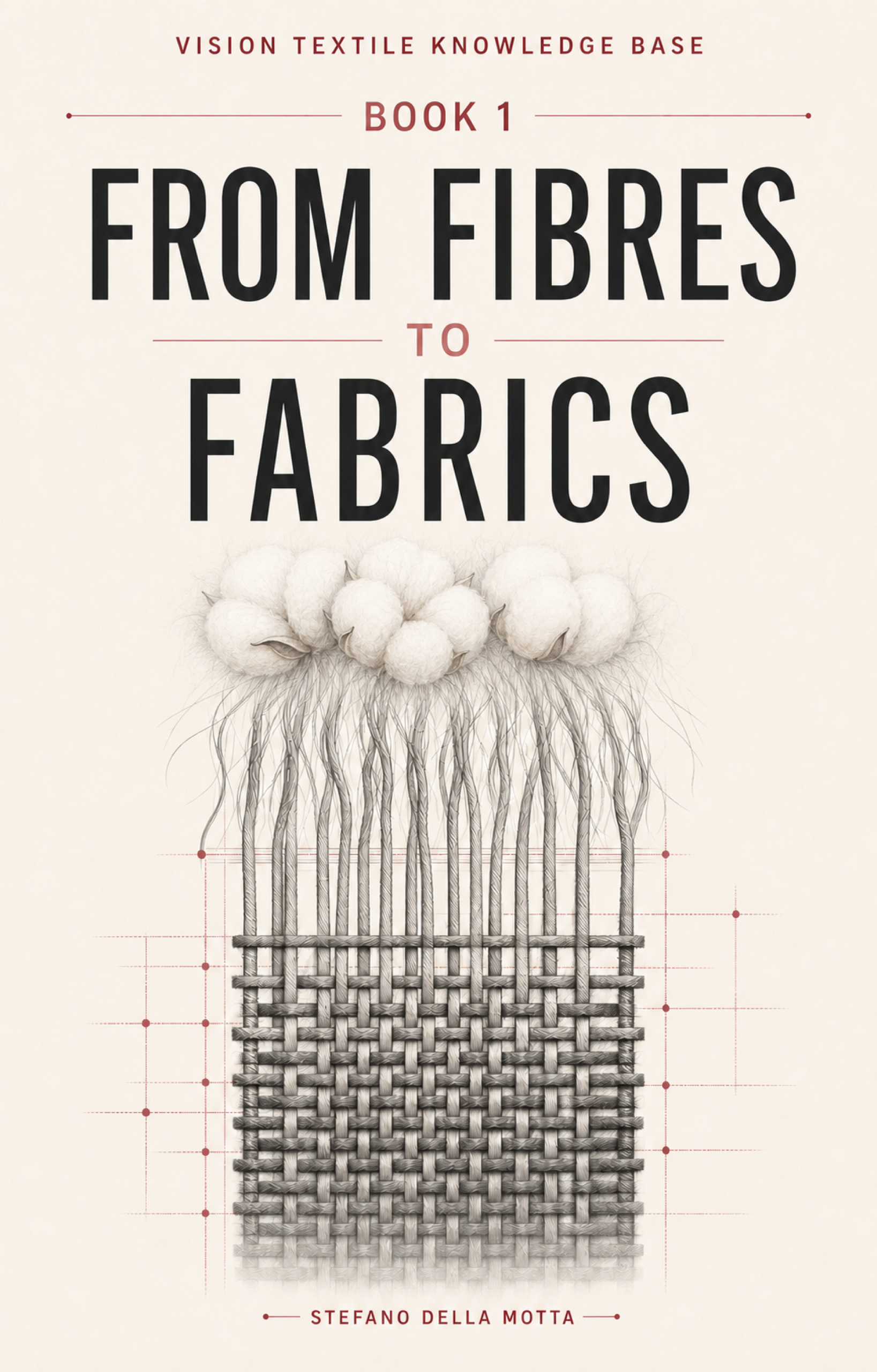
Vision Textile Knowledge Base — Book 1 cover
Public previewSelected pages from the complete digital manual
Vision Textile Knowledge Base · Book 1Extract from the complete edition

Inside the manual

Preface

This book is conceived as a practical and editorial knowledge base for textile materials, construction, quality control, certifications, and finishes. The aim is not only to list information, but to arrange it in a readable, premium, and consistent form that can support both study and professional use.

The manuscript grows from a single source of truth. Chapters are split by subject, technical cards are kept structured, and visual language is kept restrained so the content stays central.

Textile quality is rarely explained by one variable. Fibre selection influences spinning; yarn structure influences knitting and weaving; construction influences dyeing and finishing; and every stage influences the final garment. The manual therefore follows the textile chain from raw material to control, showing how apparently separate decisions become connected risks.

The intended reader may be a designer, buyer, merchandiser, technician, inspector, laboratory specialist, production manager, or student. Technical language is retained where precision matters, but every chapter is organised to support practical decisions: what the material is, how it behaves, what can go wrong, how to inspect it, and what evidence is required before making a claim.

How to Use This Book

Use this book as a layered reference. The front matter explains the conventions, the main chapters present the textile taxonomy, and the appendices are designed to host lookup material, matrices, and regulatory references.

Begin with the chapter introduction when learning a subject. Use the comparison tables to shortlist materials or processes, and use the technical cards for a quick review of properties, applications, risks, and recommended controls. The QC matrices connect a visible problem or commercial claim to the evidence needed for a decision.

Each method number identifies a testing framework, not a universal pass/fail limit. Always read the current method, customer manual, sampling plan, and product specification together. When two methods appear similar, do not combine results unless their apparatus, specimen preparation, assessment scale, and reporting rules are demonstrably equivalent.

For sourcing and claim approval, follow the evidence chain:

1. Confirm the generic material identity. 2. Confirm the supplier and production site. 3. Check the scope and validity of certificates. 4. Match transaction documents to the actual order and quantity. 5. Verify composition and performance with risk-based testing. 6. Approve label and marketing language for the destination market.

The digital edition supports search and rapid navigation. The print edition is designed for linear reading, annotation, and reference at the inspection table or laboratory desk.

Contents
The textile chain,
from material to control.

Vision Textile Knowledge Base · Book 1Extract from the complete edition

Chapter 01 · Natural Plant Fibres

Chapter 01

Natural Plant Fibres

Technical reference chapter

Classification

Plant fibres are generally divided by botanical source and by the part of the plant from which the fibre is obtained. That distinction is important because it affects length, fineness, strength, processability, and the kind of impurities or variation that can appear in production.

Botanical sourceExamplesTypical formMain QC focus
Seed or fruitCotton, kapok, coirSeed hair or fruit-husk fibreMaturity, cleanliness, length, migration
Bast or stemFlax, hemp, ramie, jute, kenafBundles from stem tissuesRetting, fibre bundles, slubs, stiffness
LeafSisal, abaca, pineapple, agaveStructural fibres from leaves/sheathsCoarseness, splinters, abrasion, stiffness
Special processed plant materialPaper yarn, mechanically processed bambooStrips, paper, or extracted bundlesWet strength, construction, correct naming
Vision Textile Knowledge Base · Book 1Extract from the complete edition

Cotton: quality, identity and control

Cotton fibre quality

Cotton quality is multidimensional. A commercial origin, variety, or premium name cannot replace measured bale data and a spinning trial. The properties below interact: a long average length does not compensate automatically for poor uniformity, weak fibre, immaturity, contamination, or excessive short-fibre content.

PropertyMeaningManufacturing and product effect
Upper-half mean length (UHML)Average length of the longer half of fibres by mass in the tested beardInfluences the feasible yarn count, drafting control, strength, hairiness, fly, and spinning efficiency
Length uniformity indexMean length expressed relative to UHMLLow uniformity indicates a wider length distribution and usually more short fibres and drafting risk
Short-fibre content/indexProportion or index of fibres below the method’s defined limitRaises waste, fly, hairiness, unevenness, imperfections, pilling risk, and end breakage
MicronaireAir-permeability value influenced jointly by fineness and maturityValues that are too low may indicate immature fibre and dyeing risk; high values can indicate coarse fibre or high maturity
MaturityDegree of secondary-wall developmentImmature fibres are weaker, form neps easily, absorb dye differently, and can appear as white specks
StrengthBundle breaking force, commonly reported in grams per texSupports finer and stronger yarns and higher processing speeds, subject to length and uniformity
ElongationFibre extension before ruptureAffects processing behaviour and the balance between strength and brittleness
ColourReflectance and yellowness, together with visual grade where applicableInfluences bleaching demand, achievable whiteness, shade consistency, and lot mixing
Trash and leafNon-lint content, particle count, and visual leaf gradeIncreases cleaning load, waste, defects, and contamination risk
Neps and seed-coat fragmentsEntangled fibre knots or fragments remaining from crop and preparationCause yarn faults, dye specks, surface defects, and optical contamination
Moisture and preparationMoisture state and quality of ginning/bale preparationAffect mass, opening, fibre damage, storage, and comparability of results

Staple-length classes

Length terminology is not universal: the measurement method, crop/classing system, and whether the value is UHML, mean length, or hand staple must be stated. As a practical reference, the Cotton Incorporated U.S. fibre-property chart rates UHML as follows:

UHML in inchesApproximate millimetresRating in this reference
Below 0.99Below 25.1 mmShort
0.99-1.1025.1-27.9 mmMedium
1.11-1.2628.2-32.0 mmLong
Above 1.26Above 32.0 mmExtra long

These bands are a comparative guide, not a universal purchasing specification. Specify the actual measured distribution, short-fibre method, spinning system, yarn count, end use, and lot-mixing rules.

Pima cotton

Pima is the commercial name used in the United States for extra-long-staple cotton of Gossypium barbadense. USDA/Cotton Incorporated classification material describes American Pima fibres at approximately 1¼ to 1 9/16 inches, or about 31.8 to 39.7 mm. The longer, fine and strong fibres can support fine, smooth, strong yarns with low hairiness, good lustre, soft handle, and clear colour when the fibre is mature and correctly processed.

“Pima” must not be treated as an automatic guarantee of every quality parameter. Confirm species/type, origin claim, UHML, uniformity, strength, micronaire or independent fineness/maturity data, colour, contamination, bale identity, and chain of custody. A blend containing only a proportion of Pima must not be described as though the whole cotton content were Pima.

SUPIMA®

SUPIMA® is not a separate generic fibre. It is a registered trademark used for U.S.-grown American Pima extra-long-staple cotton supplied through the programme’s licensed and traceable chain. The trademark therefore combines a defined raw-material origin with brand, licensing, transaction, and authentication requirements.

Do not use “Supima” as a synonym for all Pima or all extra-long-staple cotton. Before making a SUPIMA® claim, verify the current licence status of the relevant supply-chain parties, eligible fibre inventory, transaction-level traceability, product composition, trademark approval, and current labelling or hangtag rules. Fibre quality still has to be confirmed from bale and production data; trademark eligibility does not replace manufacturing control.

Sample card: Cotton

FieldContent
Fibre familyNatural plant fibre
Botanical sourceGossypium species
Main identitySoft, breathable, versatile staple fibre
Typical strengthsComfort, absorbency, dye affinity, wide commercial use
Main risksContamination, uneven maturity, strength variation, finish sensitivity
Recommended checksFibre composition, contamination review, yarn and fabric appearance, shrinkage and dimensional stability
Vision Textile Knowledge Base · Book 1Extract from the complete edition

Chapter 07 · Yarns

Chapter 07

Yarns

Technical reference chapter

Bale selection, opening, and mixing

Raw fibre arrives in compressed bales or packages with differences in origin, grade, colour, moisture, length, fineness, maturity, strength, contamination, finish, and price. A laydown combines bales so that short-term variation is averaged across a production lot. Bale management is therefore both a quality and traceability operation.

The bale opener removes small tufts progressively rather than tearing large compact masses. Subsequent mixers create residence time and repeated redistribution. The target is a homogeneous blend without unnecessary fibre rupture or nep formation.

Control:

  • bale identity, grade, moisture, and certification status;
  • laydown plan and permitted blend tolerances;
  • tuft size and opening intensity;
  • metal, plastic, polypropylene, coloured fibre, and foreign-matter detection;
  • extraction and fire protection;
  • waste classification and reconciliation;
  • changeover cleaning between colours, fibre types, and certified lots.

Blending can combine equivalent lots, different fibre properties, different colours for mélange yarn, or different fibre types. A blend percentage stated on the final product must be protected through weigh-pan accuracy, stock records, waste accounting, and composition testing.

Vision Textile Knowledge Base · Book 1Extract from the complete edition

Chapter 08 · Fabric Constructions

Chapter 08

Fabric Constructions

Technical reference chapter

Weave notation and messa in carta

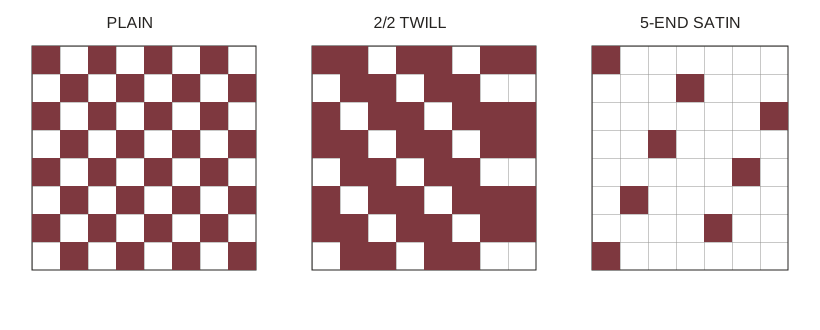
A weave draft or point-paper plan uses a square grid. Columns normally represent warp ends and rows represent weft picks. A filled square commonly indicates that the warp is raised over the weft, although conventions must be stated.

The complete weaving plan may contain:

  • weave or interlacing plan;
  • drawing-in draft through heddle shafts;
  • lifting or peg plan;
  • tie-up between shafts and treadles or dobby controls;
  • denting plan through the reed;
  • colour-and-weave plan;
  • selvedge construction.

Figure 8.1 places the three essential notations side by side. Reading the filled squares by columns and rows reveals the frequency of interlacing and the direction of the repeat.

Point-paper weave plans
Figure 8.1 — Messa in carta for plain weave, 2/2 twill, and satin, with warp ends shown vertically and weft picks horizontally.

Plain weave alternates warp-up and warp-down at every crossing. A 2/2 twill advances the interlacing point to create a diagonal. Satin distributes binding points to avoid adjacent interlacings and create long floats.

Vision Textile Knowledge Base · Book 1Extract from the complete edition

Chapter 09 · Dyeing Processes

Chapter 09

Dyeing Processes

Technical reference chapter

Where colour enters the textile chain

Colour can be introduced at polymer solution or melt, loose fibre, top or stock, yarn, fabric, garment, print, or surface-coating stage. Earlier coloration normally provides stronger penetration and large-lot consistency but reduces commercial flexibility. Later coloration allows rapid response and product effects but introduces more dimensional, seam, trim, and shade risks.

Application stagePrincipal advantagePrincipal limitationTypical control
Dope/solution colorationExcellent penetration and fastness potentialHigh minimum quantity and reduced colour flexibilityPolymer/additive dosing and masterbatch dispersion
Fibre/stock dyeingMélange and intimate blend effectsExtra blending and inventory complexityFibre damage, blend ratio, shade distribution
Top dyeingControlled colour before worsted spinningLong process route and lot planningTop evenness, penetration, moisture
Yarn dyeingStripes, checks, jacquards and high penetrationPackage-density and channeling risksPackage build, flow, pressure and inside/outside shade
Piece dyeingFlexible solid-colour productionFabric crease, rope mark, listing and dimensional risksMachine loading, liquor flow, temperature and fabric path
Garment dyeingRapid response and washed-down effectsComponent mismatch, seam damage and measurement changeCompatible thread/trims, construction and garment loading
Printing/coatingLocalised colour or graphic effectRegistration, penetration, crocking and hand changesPaste rheology, fixation, washing-off and alignment
Vision Textile Knowledge Base · Book 1Extract from the complete edition

Package yarn dyeing

Package yarn dyeing

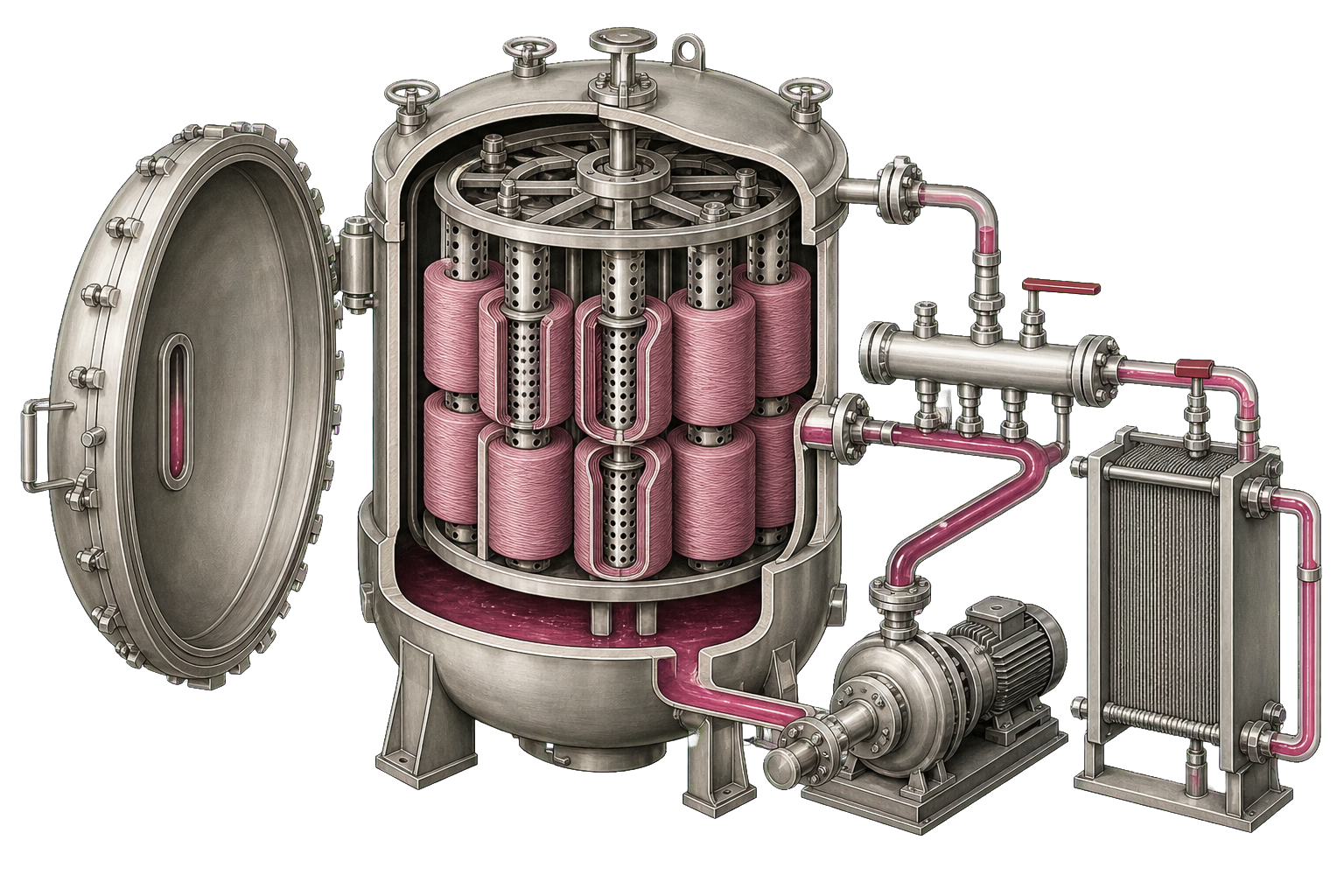
Yarn is wound onto perforated cones, springs, or tubes and loaded on spindles inside a pressurised vessel. Liquor alternates from inside-to-outside and outside-to-inside. Package density, winding tension, tube perforation, spindle sealing, flow rate, differential pressure, and loading geometry determine penetration.

Package-yarn dyeing machine
Figure 9.1 — Cutaway pressure vessel with perforated package carriers, pump, heat exchanger, and reversible liquor circuit for inside-to-outside and outside-to-inside flow.

Figure 9.1 exposes the package carrier and circulation circuit. The pump and heat exchanger condition the bath before it is directed through the perforated spindles and yarn layers; reversing the flow reduces the difference between the inner and outer package zones.

Hard packages may resist flow; soft packages may deform or allow channeling. Inspect inner, middle, and outer package layers. After dyeing, controlled hydroextraction, drying, rewinding, waxing, or clearing may be required.

Vision Textile Knowledge Base · Book 1Extract from the complete edition

Chapter 11 · Textile Defects

Chapter 11

Textile Defects

Technical reference chapter

Fibre defects

Contamination, immature fibre, coarse hair, excessive short fibre, neps, vegetable matter, colour variation, and foreign matter can survive multiple processes. Raw-material sampling should reflect bales, lots, positions, and time. Once fibres are blended, origin becomes harder to isolate.

Classification by severity

Severity is defined by customer requirements and end use.

ClassPractical meaningTypical disposition
CriticalUnsafe, illegal, or presents serious compliance riskReject/contain immediately and escalate
MajorLikely to cause failure, return, or unacceptable appearanceReject according to sampling plan
MinorDeparture that does not materially impair intended useRecord and decide under agreed limit

Defect classification and sampling plan are separate decisions. AQL is not a licence to ship known defects and does not replace process control. Critical defects may be assigned a zero-acceptance rule even when other classes use statistical sampling.

Root-cause workflow

1. Contain affected material and identify the last known good output. 2. Confirm the defect against an approved standard. 3. Map frequency, location, direction, and lot boundaries. 4. Compare raw material, machine, operator, recipe, environment, and time. 5. Reproduce the failure where possible. 6. Implement corrective action and verify effectiveness on new production. 7. Update the control plan, not only the inspection report.

Vision Textile Knowledge Base · Book 1Extract from the complete edition

Chapter 12 · Laboratory Tests

Chapter 12

Laboratory Tests

Technical reference chapter

Sampling and conditioning

Sampling should represent production lots, colours, sizes, positions, and risk. Avoid damaged roll ends unless the purpose is defect investigation. Textiles are conditioned in a specified standard atmosphere before tests affected by moisture. Record departures and do not compare conditioned and unconditioned results as if equivalent.

Pilling

Pilling methods abrade or tumble specimens under controlled conditions and assess surface change against standards. Method families are not interchangeable. State apparatus, cycle, loading, assessment scale, and whether fuzzing, pilling, and matting were rated separately.

Figure 12.1 shows a multi-station Martindale instrument. Circular specimens move against the specified abradant under controlled load and a defined Lissajous motion; holders, loading pieces, abradant, cycle count, conditioning, and assessment interval must match the selected method.

Martindale pilling and abrasion tester
Figure 12.1 — A multi-station Martindale tester controls specimen motion and load; the holder and test assembly change according to the selected pilling or abrasion method.
Vision Textile Knowledge Base · Book 1Extract from the complete edition

Strength, seam and colour fastness

Tensile, tear and bursting strength

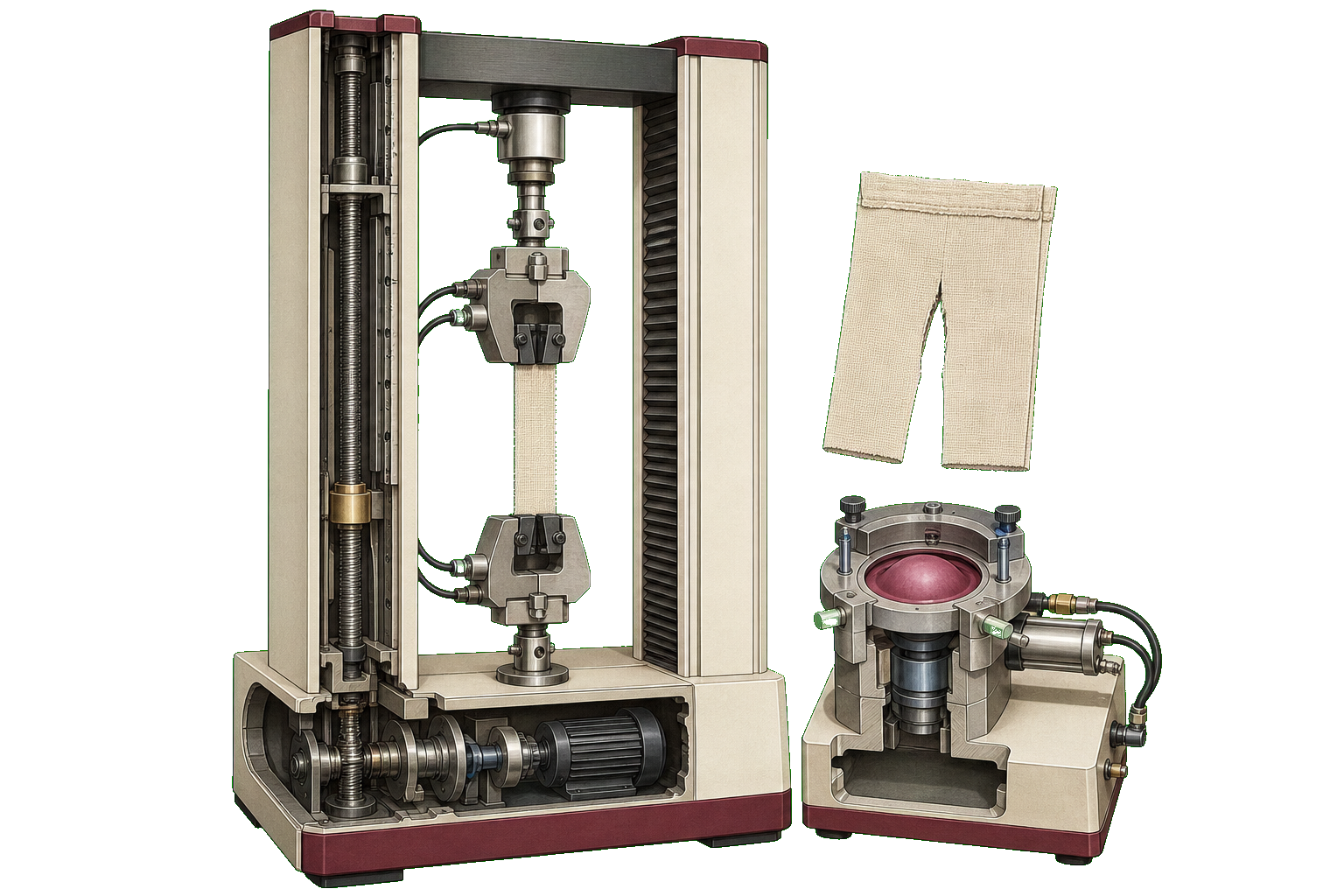
Strip or grab tensile tests measure resistance to an increasing uniaxial force. Tear tests measure propagation of an existing cut or rupture. Bursting tests apply multidirectional stress and are often appropriate for knits. Results cannot be substituted across methods because the stress state and specimen geometry differ.

Figure 12.2 compares the loading principles: opposed grips apply uniaxial tension to a strip, a prepared cut directs tear propagation, and a diaphragm or pneumatic head loads a clamped specimen multidirectionally for bursting. The illustration explains the stress state, not an interchangeable test result.

Universal tensile, tear, and bursting test arrangements
Figure 12.2 — Tensile, tear, and bursting tests load textiles in fundamentally different ways and therefore require their own specimen geometry, apparatus, and acceptance limit.

Colour fastness

Fastness evaluates resistance to specified agencies such as washing, rubbing, perspiration, water, light, chlorinated water, seawater, dry cleaning, heat, or storage. Report colour change and staining separately using the specified scales or instrumental assessment. Dark shades, prints, contrast panels, and fluorescent colours may require additional controls.

Vision Textile Knowledge Base · Book 1Preview ends here

Chapter 13 · Certifications and Claims

Chapter 13

Certifications and Claims

Technical reference chapter

GOTS and OCS

GOTS covers certified organic fibres together with processing, chemical, environmental, social, and chain-of-custody requirements. GOTS 8.0 was released in March 2026; official transition dates and current labelling conditions must be checked before approval. A finished-product GOTS claim requires the relevant certified chain and approved labelling, not merely organic fibre from a certified upstream supplier.

The Organic Content Standard verifies the presence and chain of custody of certified organic material. It does not provide the same processing and chemical criteria as GOTS. Select the scheme according to the claim being made.

Claim verification

CheckEvidence
Standard identity and versionOfficial standard-owner publication
Supplier certificationValid scope certificate in official database
Product/process coverageProduct appendix and process categories
Shipment coverageTransaction certificate or scheme-required evidence
Quantity consistencyPurchase, stock, production loss, sales records
Label wordingCurrent claims and labelling policy
Logo useWritten approval/licence where required
Public statementLegal and marketing review for each market

Red flags

  • Certificate supplied only as a cropped image.
  • Company name, address, or licence number does not match the invoice.
  • Certificate valid dates do not cover production or transaction.
  • Product or process is outside the certified scope.
  • Transaction quantity exceeds plausible certified input.
  • A logo appears without certification-body or licence information required by the scheme.
  • The claim changes from “sourced” to “contains” without physical-content evidence.
  • The finished product is described as certified when only raw material is covered.
Language editionsRequest availability

Request a copy in your language

Tell us which edition you need.

Leave your email and preferred language. We will contact you when that edition is available.